
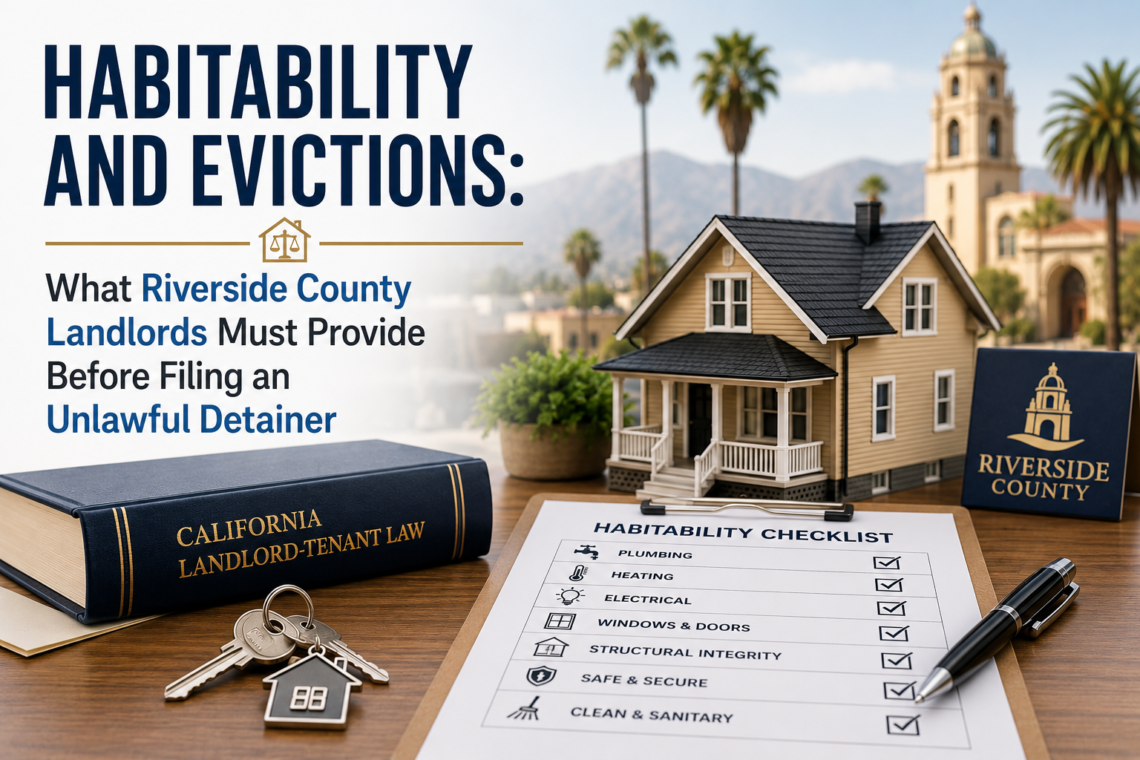
If you own rental property in Riverside, Moreno Valley, Corona, Temecula, or anywhere else in Riverside County, habitability is not just a maintenance issue — it can decide the outcome of your eviction case. When a landlord files an unlawful detainer for nonpayment of rent, one of the most common responses is a habitability defense: the tenant argues the unit was untenantable, and under Code of Civil Procedure § 1174.2 the court can reduce the rent owed and even deny possession. Before serving a 3-day notice, every Riverside County landlord should know exactly what California law requires them to provide. Here is the full statutory picture.
California landlords must provide and maintain rental dwelling units that are tenantable, sanitary, safe, weatherproof, supplied with essential utilities and facilities, and free from conditions that qualify the unit or premises as a substandard building. The core statutory habitability requirements are set out in California Civil Code § 1941.1, which deems a dwelling untenantable if it substantially lacks specified minimum characteristics or is a residential unit described in Health and Safety Code § 17920.3 or § 17920.10. Landlords must also install and maintain specified security devices under California Civil Code § 1941.3, smoke alarms under Health and Safety Code § 13113.7, and carbon monoxide devices where required under Health and Safety Code §§ 17926 and 17926.1. The Health and Safety Code further defines “substandard building” conditions, including inadequate sanitation, structural hazards, faulty weather protection, unsafe wiring, unsafe plumbing or mechanical equipment, nuisance conditions, infestation, visible mold, inadequate exits, and fire hazards. Health and Safety Code § 17920.3.
The Baseline: California Civil Code § 1941.1 Habitability Requirements
California Civil Code § 1941.1 supplies the baseline statutory definition of when a dwelling is deemed “untenantable” for purposes of the landlord’s duty under Civil Code § 1941. A dwelling is deemed untenantable if it substantially lacks any of the statute’s listed affirmative standard characteristics, or if it is a residential unit described in Health and Safety Code § 17920.3 or § 17920.10. Cal. Civ. Code § 1941.1(a).
Under Civil Code § 1941.1, the dwelling must have the following characteristics:
- Effective waterproofing and weather protection of the roof and exterior walls, including unbroken windows and doors.
- Plumbing and gas facilities that conformed to applicable law when installed and are maintained in good working order.
- An approved water supply under tenant control, or a landlord-controlled system, capable of producing hot and cold running water, furnished to appropriate fixtures, and connected to an approved sewage disposal system.
- Heating facilities that conformed to applicable law when installed and are maintained in good working order.
- Electrical lighting, wiring, and electrical equipment that conformed to applicable law when installed and are maintained in good working order.
- Clean and sanitary buildings, grounds, appurtenances, and landlord-controlled areas, free from accumulations of debris, filth, rubbish, garbage, rodents, and vermin.
- Adequate garbage and rubbish receptacles, in clean condition and good repair at the commencement of the tenancy, with the landlord thereafter providing appropriate serviceable receptacles and maintaining those under the landlord’s control.
- Floors, stairways, and railings maintained in good repair.
- A locking mail receptacle for each residential unit in a residential hotel, as required by Health and Safety Code § 17958.3.
- For leases entered into, amended, or extended on or after January 1, 2026, subject to statutory exceptions, a stove maintained in good working order and capable of safely generating heat for cooking.
- For leases entered into, amended, or extended on or after January 1, 2026, subject to statutory exceptions and tenant-election rules, a refrigerator maintained in good working order and capable of safely storing food.
Civil Code § 1941.1 also provides that a stove or refrigerator subject to recall by the manufacturer or a public entity is not capable of safely performing its statutory function. A landlord must repair or replace a recalled stove or refrigerator within 30 days after receiving notice of the recall, without limiting the tenant’s remedies under Civil Code § 1942. Cal. Civ. Code § 1941.1(c).
Security Devices: Dead Bolts, Window Locks, and Common-Area Exterior Doors
California Civil Code § 1941.3 imposes separate security-device requirements on landlords of buildings intended for human habitation. The landlord or landlord’s agent must install and maintain:
- An operable dead bolt lock on each main swinging entry door of a dwelling unit, installed according to manufacturer specifications and applicable state and local codes, including fire, life-safety, and disability-access requirements. The statute specifies minimum bolt-extension requirements and recognizes certain existing locks or approved alternative devices.
- Operable window security or locking devices for windows designed to be opened, subject to exclusions for louvered windows, casement windows, and windows located more than 12 feet vertically or six feet horizontally from the ground, a roof, or another platform.
- Locking mechanisms on exterior doors that provide ingress or egress to common areas with access to dwelling units in multifamily developments, where such doors exist, and in compliance with applicable fire and safety codes.
Cal. Civ. Code § 1941.3(a).
The tenant must notify the owner or authorized agent when the tenant becomes aware of an inoperable dead bolt lock or window security or locking device in the dwelling unit. The landlord is not liable for a violation of subdivision (a) unless the landlord fails to correct the violation within a reasonable time after actual notice or receipt of notice of the deficiency. Cal. Civ. Code § 1941.3(b).
Tenant remedies for a landlord’s violation include remedies under Civil Code §§ 1942, 1942.4, and 1942.5, an action for breach of contract, injunctive relief under Code of Civil Procedure § 526, and, in an unlawful detainer action following rent default, the ability to raise the violation as an affirmative defense and seek remedies under Code of Civil Procedure § 1174.2. Cal. Civ. Code § 1941.3(c).
Smoke Alarm Requirements for California Rentals
Health and Safety Code § 13113.7 requires approved and listed smoke alarms to be installed, in accordance with the manufacturer’s instructions, in each dwelling intended for human occupancy, except as otherwise provided in the statute. Cal. Health & Safety Code § 13113.7(a). The statute defines covered “dwelling units intended for human occupancy” to include one- or two-unit dwellings, lodging houses, apartment complexes, hotels, motels, condominiums, stock cooperatives, time-share projects, dwelling units of multiple-unit dwelling complexes, and factory-built housing, while excluding manufactured homes, mobilehomes, and commercial coaches as separately defined. Cal. Health & Safety Code § 13113.7(b).
For rental housing, the owner’s obligations include the following:
- At the creation of a new tenancy, the owner must ensure that required smoke alarms are operable.
- The tenant must notify the manager or owner if the tenant becomes aware of an inoperable smoke alarm within the unit.
- The owner or authorized agent must correct reported smoke-alarm deficiencies.
- The owner or agent may enter the unit to install, repair, test, and maintain required single-station smoke alarms, but except in emergencies must give reasonable written notice and enter only during normal business hours; 24 hours is presumed reasonable absent contrary evidence.
- Owners of rented or leased dwelling units were required, by January 1, 2016, to install additional smoke alarms as needed to comply with current building standards, subject to statutory qualifications for existing alarms and certain fire-alarm systems.
Cal. Health & Safety Code § 13113.7(d).
A violation of § 13113.7 is an infraction punishable by a maximum fine of $200 for each offense, and the statute does not affect other rights the parties may have under other law because of the presence or absence of a smoke alarm. Cal. Health & Safety Code § 13113.7(e)–(f).
Health and Safety Code §§ 17920–17928: Building Standards and Substandard Conditions
Health and Safety Code §§ 17920–17928 are part of California’s statutory framework for regulating buildings used for human habitation. They define key terms, authorize building standards and regulations, incorporate uniform industry codes and California Building Standards Code requirements, and identify specific safety requirements relevant to rental habitability.
What Counts as a “Substandard Building” in California?
Health and Safety Code § 17920 defines terms used in this part. Of particular importance, it defines a “substandard building” as a building, or portion of a building, including any building used for human habitation, that is declared substandard under Health and Safety Code § 17920.3. Cal. Health & Safety Code § 17920(n).
Health and Safety Code § 17920.3 then provides that any building or portion of a building, regardless of zoning designation or approved uses, including any dwelling unit, guestroom or suite of rooms, or the premises on which the same is located, is deemed a substandard building if listed conditions exist to an extent that endangers life, limb, health, property, safety, or welfare of occupants, nearby residents, or the public. Cal. Health & Safety Code § 17920.3.
The listed substandard conditions include, among others:
- Inadequate sanitation, including lack of or improper water closet, lavatory, bathtub or shower, kitchen sink, hot and cold running water, adequate heating, required ventilation, required natural light and ventilation, room and space dimensions, required electrical lighting, sewage connection, or adequate garbage and rubbish storage and removal facilities.
- Dampness of habitable rooms.
- Infestation of insects, vermin, or rodents, as determined by an authorized health or code enforcement officer.
- Visible mold growth, as determined by an authorized health or code enforcement officer, excluding minor mold on surfaces that can accumulate moisture as part of their proper and intended use.
- General dilapidation or improper maintenance.
- Structural hazards, including deteriorated or inadequate foundations, defective or deteriorated floors or supports, unsafe vertical or horizontal supports, and unsafe fireplaces or chimneys.
- Nuisance conditions.
- Unsafe or noncompliant wiring, plumbing, and mechanical equipment, subject to statutory exceptions for systems that conformed when installed and remain in good, safe, and working condition.
- Faulty weather protection, including deteriorated or ineffective waterproofing, broken windows or doors, and deteriorated exterior wall or roof coverings.
- Fire or explosion hazards, including unsafe equipment, combustible waste, or vegetation.
- Accumulations on premises of weeds, vegetation, junk, debris, garbage, rodent harborages, stagnant water, combustible materials, and similar hazards.
- Unsafe buildings due to inadequate maintenance.
- Inadequate exits, fire-resistive construction, or fire-extinguishing systems or equipment required by applicable law.
- Improper occupancy of buildings or portions of buildings for living, sleeping, cooking, or dining where not designed or intended for those occupancies.
- Inadequate structural resistance to horizontal forces.
Cal. Health & Safety Code § 17920.3(a)–(o).
Because Civil Code § 1941.1 expressly incorporates Health and Safety Code § 17920.3, a rental dwelling may be deemed untenantable not only when it substantially lacks the affirmative characteristics listed in Civil Code § 1941.1, but also when it is a residential unit described by the Health and Safety Code’s substandard-building provisions. Cal. Civ. Code § 1941.1(a).
Who Sets and Enforces California’s Building, Housing, Fire, and Safety Standards?
Health and Safety Code § 17921 authorizes the Department of Housing and Community Development to propose, adopt, amend, and repeal building standards and other rules and regulations for protection of public health, safety, and general welfare governing the erection, construction, enlargement, conversion, alteration, repair, moving, removal, demolition, occupancy, use, sanitation, ventilation, and maintenance of hotels, motels, lodging houses, apartment houses, dwellings, and accessory buildings and structures. Cal. Health & Safety Code § 17921(a).
The same section authorizes the State Fire Marshal to adopt, amend, and repeal building standards and other regulations for fire and panic safety in hotels, motels, lodging houses, apartment houses, dwellings, and accessory buildings and structures, with enforcement under the fire-safety enforcement statutes. Cal. Health & Safety Code § 17921(b).
Health and Safety Code § 17922 incorporates the California Building Standards Code and related rules and regulations, requiring standards that impose substantially the same requirements as specified international and uniform codes, including the Uniform Housing Code, International Building Code, International Residential Code, Uniform Plumbing Code, Uniform Mechanical Code, National Electrical Code, and International Existing Building Code. Cal. Health & Safety Code § 17922(a). For existing buildings, alteration and repair rules must permit replacement, retention, and extension of original materials and methods so long as the building complies with applicable standards and does not become or continue as a substandard building. Cal. Health & Safety Code § 17922(d).
Health and Safety Code § 17923 allows approved alternate materials, appliances, installations, devices, arrangements, or methods of construction if they are at least equivalent to prescribed requirements in performance, safety, and protection of life and health. The Department may require tests at the owner’s or agent’s expense to prove compliance or substantiate claims for alternates. Cal. Health & Safety Code § 17923.
Health and Safety Code § 17924 confirms that rules and regulations must be promulgated under the Administrative Procedure Act and that building standards must be proposed and submitted for adoption and publication under the California Building Standards Law. Cal. Health & Safety Code § 17924.
Carbon Monoxide Detector Requirements
Health and Safety Code § 17926 requires an owner of a dwelling unit intended for human occupancy to install an approved and listed carbon monoxide device in each existing dwelling unit that has a fossil-fuel-burning heater or appliance, fireplace, or attached garage. The devices must be installed within the applicable statutory deadlines, which have passed for the categories listed in the statute. Cal. Health & Safety Code § 17926(a). The number and placement of carbon monoxide devices must be consistent with building standards applicable to new construction for the relevant occupancy or with the manufacturer’s instructions, if technically feasible. Cal. Health & Safety Code § 17926(b).
For rental units, Health and Safety Code § 17926.1 requires the owner or owner’s agent who rents or leases a dwelling unit intended for human occupancy to maintain carbon monoxide devices in the unit consistent with §§ 17926 and 17926.1. Cal. Health & Safety Code § 17926.1(a). The device must be operable when the tenant takes possession. The tenant must notify the owner or agent if the tenant becomes aware of an inoperable or deficient device, and the owner or agent must correct reported deficiencies or inoperabilities. The owner is not in violation for a deficient or inoperable device when the owner has not received notice of the deficiency or inoperability. Cal. Health & Safety Code § 17926.1(c).
Garage Door Spring Safety Standards
Health and Safety Code § 17927 directs the Department to adopt standards and regulations for garage door springs installed in garages accessory to apartment houses, hotels, motels, and dwellings, as reasonably necessary to prevent death, injury, or property damage from broken springs. It also prohibits the sale, offering for sale, or installation of noncompliant garage door springs in such garages after the effective date of applicable standards or regulations. Cal. Health & Safety Code § 17927.
Sections 17925 and 17928: The Standards-Development Framework
Health and Safety Code § 17925 concerns objections to proposed building standards and related hearing procedures; it is part of the statutory framework for adoption and application of building standards but does not itself impose a separate day-to-day habitability duty on landlords comparable to Civil Code § 1941.1, Civil Code § 1941.3, Health and Safety Code § 13113.7, or Health and Safety Code §§ 17920.3, 17926, and 17926.1. Cal. Health & Safety Code § 17925.
Health and Safety Code § 17928 addresses green building standards. It requires the Department of Housing and Community Development, for building standards submitted to the California Building Standards Commission for adoption in the 2010 California Building Code or later, to review relevant green building guidelines as necessary and consider proposing as mandatory those green building features determined to be cost-effective and feasible to promote greener construction. It also requires periodic reporting to the Legislature. Cal. Health & Safety Code § 17928. Like § 17925, § 17928 is principally part of the standards-development framework rather than a direct landlord-maintenance provision, but it informs the building-standard regime applicable to dwellings.
Riverside County Landlord Habitability Checklist: What the Law Requires
Taken together, these statutes require California landlords to do at least the following for rental dwellings:
- Provide and maintain core habitability features: weatherproofing, functioning plumbing and gas facilities, hot and cold water, sewage connection, heating, electrical systems, sanitation, garbage receptacles, floors, stairways, railings, and any other statutorily required features. Cal. Civ. Code § 1941.1.
- Avoid substandard-building conditions: ensure the dwelling and premises do not contain dangerous inadequate sanitation, structural hazards, nuisance conditions, unsafe wiring, unsafe plumbing, unsafe mechanical equipment, faulty weather protection, fire hazards, infestation, visible mold, general dilapidation, inadequate exits, or other listed conditions endangering occupants or the public. Cal. Health & Safety Code § 17920.3.
- Install and maintain security devices: provide required dead bolts, window locks or security devices, and common-area exterior-door locking mechanisms in covered properties, subject to the statute’s exclusions and notice-and-cure rule. Cal. Civ. Code § 1941.3.
- Install, test, and maintain smoke alarms: provide approved smoke alarms, ensure operability at the start of a tenancy, and correct reported deficiencies. Cal. Health & Safety Code § 13113.7.
- Install and maintain carbon monoxide devices where required: provide approved devices in covered dwelling units with fossil-fuel-burning heaters or appliances, fireplaces, or attached garages, ensure operability at tenant possession, and correct reported deficiencies. Cal. Health & Safety Code §§ 17926, 17926.1.
- Comply with applicable building, housing, fire, life-safety, and maintenance standards, including the California Building Standards Code and other standards and regulations adopted under Health and Safety Code §§ 17921–17924 and related provisions. Cal. Health & Safety Code §§ 17921–17924.
Why This Matters in Your Riverside Eviction Case
California’s statutory habitability scheme requires landlords to provide rental units that meet affirmative minimum conditions under Civil Code § 1941.1, are not substandard under Health and Safety Code § 17920.3, and include specific safety and security features such as dead bolts, window locks, smoke alarms, and carbon monoxide devices where required. The Health and Safety Code provisions in §§ 17920–17928 operate alongside the Civil Code by defining substandard and unsafe conditions and establishing the building-standard framework that informs whether a dwelling is safe, sanitary, and fit for human habitation.
In practice, this means the strongest position a Riverside County landlord can take into an unlawful detainer is a documented record of compliance: repairs completed promptly after notice, working smoke and carbon monoxide alarms at move-in, and no outstanding code enforcement issues. A habitability defense that has no facts to stand on rarely slows an eviction down. One that does can cost you months of possession and thousands in reduced rent.
If you are preparing to evict a tenant in Riverside County and want to make sure a habitability defense will not derail your case, contact our office for a consultation before you serve notice.


